
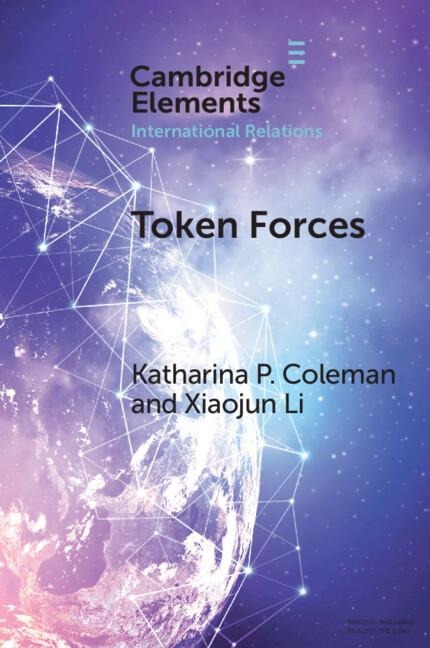
Token Forces - Xiaojun Li,Katharina P Coleman
-30% ar kodu BOOKS
Piegāde 22-28 darba dienu laikā
30 dienu atgriešanas politika
"How and why did token troop contributions - tiny military deployments within much larger coalitions - become the most common form of state participation in UN peace operations? In December 2020, the UN mission in the Democratic Republic of Congo (MONUSCO) had 48 troop contributing countries (TCCs) but 93 percent of its 12,758 troops were deployed by just ten states.1 35 MONUSCO troop contributors deployed ... Pilns apraksts
Aprašymas
"How and why did token troop contributions - tiny military deployments within much larger coalitions - become the most common form of state participation in UN peace operations? In December 2020, the UN mission in the Democratic Republic of Congo (MONUSCO) had 48 troop contributing countries (TCCs) but 93 percent of its 12,758 troops were deployed by just ten states.1 35 MONUSCO troop contributors deployed less than 40 troops (roughly equivalent to a platoon) each, including 27 states contributing fewer than ten troops each. Collectively, these token contributors accounted for just 200 MONUSCO troops. Likewise, 32 of the 50 TCCs in the UN mission in the Central African Republic, MINUSCA, deployed fewer than 40 troops each, jointly contributing just 168 of the mission's 11,457 military personnel. As we show in this Element, similar patterns are observable in other UN missions, consolidating from the mid-2000s onwards"--
Vairāk informācijas
| Autors | Xiaojun Li, Katharina P Coleman |
|---|---|
| Izdevējs | Cambridge University Press |
| Izlaides gads | 2022 |
| Vāka tips | Mīkstais vāks |
| EAN | 9781009048835 |