
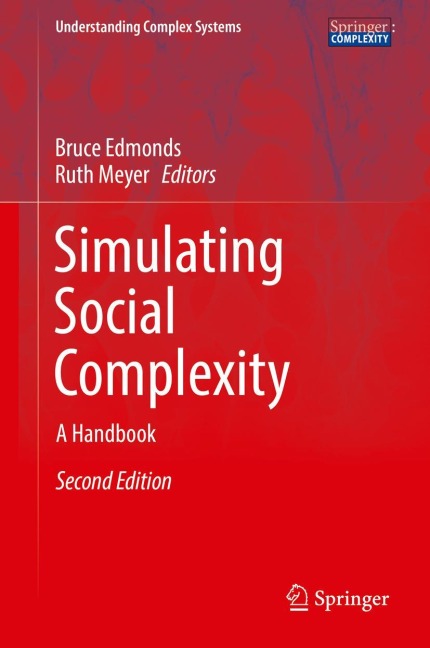
Simulating Social Complexity: A Handbook -
-40% ar kodu BOOKS
Piegāde 17-23 darba dienu laikā
30 dienu atgriešanas politika
This volume examines all aspects of using agent or individual-based simulation. This approach represents systems as individual elements having their own set of differing states and internal processes. The interactions between elements in the simulation represent interactions in the target systems. What makes this "social" is that it can represent an observed society. Social systems include all those systems ... Pilns apraksts
Jums varētu patikt arī
 TOP
TOP

The Demon-Haunted World: Science as a Candle in the Dark
-40% ar kodu BOOKS
Piegādātāja noliktavā
TOP

The Art of Uncertainty: How to Navigate Chance, Ignorance, Risk and Luck
-40% ar kodu BOOKS
Nav noliktavā
TOP

Heart Rate Variability: Science and Strategies for Peak Performance
Marco Altini, Sylvain Laborde, Dan Plews, Emma Mosley
-40% ar kodu BOOKS
Nav noliktavā
TOP

Many Faces, One Purpose: A Manager's Handbook on Women in Firefighting
U. S. Fire Administration, Homeland Security
-40% ar kodu BOOKS
Nav noliktavā
TOP

The Gulf Moment: Arab Relations Since 2011
Florence Gaub, U. S. Army War College, Strategic Studies Institute
-40% ar kodu BOOKS
Nav noliktavā
 TOP
TOP

Introduction to Algorithms
Ronald L. Rivest, Charles E. Leiserson, Clifford Stein, Thomas H. Cormen
-40% ar kodu BOOKS
Piegādātāja noliktavā
TOP

Worth Dying For: The Power and Politics of Flags
-40% ar kodu BOOKS
Piegādātāja noliktavā
TOP

The Code Book: The Science of Secrecy from Ancient Egypt to Quantum Cryptography
-40% ar kodu BOOKS
Piegādātāja noliktavā
TOP

Dinosaurs and Prehistoric Life: The Definitive Visual Guide to Prehistoric Animals
-40% ar kodu BOOKS
Piegādātāja noliktavā
TOP


Crossing Borders: About the birth of the Consortium of European Research Libraries, the organisation's early years and its path to maturity, spanning the period from the late twentieth century to the first decades of the twenty-first century
-40% ar kodu BOOKS
Piegādātāja noliktavā
TOP

101 Things I Learned in Architecture School
-40% ar kodu BOOKS
Piegādātāja noliktavā
 TOP
TOP

Playing It by the Book: Printed and Manuscript Book Games in Early Modern Europe
-40% ar kodu BOOKS
Piegādātāja noliktavā
TOP

Only Dull People Are Brilliant at Breakfast
-40% ar kodu BOOKS
Piegādātāja noliktavā
TOP

International Economics: Theory and Policy, Global Edition
Paul Krugman, Maurice Obstfeld, Marc Melitz
-40% ar kodu BOOKS
Piegādātāja noliktavā
 TOP
TOP

The Unaccountability Machine: Why Big Systems Make Terrible Decisions
-40% ar kodu BOOKS
Piegādātāja noliktavā
TOP

Nudge: Improving Decisions About Health, Wealth and Happiness
Cass R Sunstein, Richard H. Thaler
-40% ar kodu BOOKS
Noliktavā
TOP

Einhundert Zitate Female Edition: Ein Postkartenbuch mit 100 Zitaten
-40% ar kodu BOOKS
Piegādātāja noliktavā
Aprašymas
This volume examines all aspects of using agent or individual-based simulation. This approach represents systems as individual elements having their own set of differing states and internal processes. The interactions between elements in the simulation represent interactions in the target systems. What makes this "social" is that it can represent an observed society. Social systems include all those systems where the components have individual agency but also interact with each other. This includes human societies and groups, but also increasingly socio-technical systems where the internet-based devices form the substrate for interaction. These systems are central to our lives, but are among the most complex known. This poses particular problems for those who wish to understand them. The complexity often makes analytic approaches infeasible but, on the other hand, natural language approaches are also inadequate for relating intricate cause and effect. This is why individual and agent-based computational approaches hold out the possibility of new and deeper understanding of such systems. This handbook marks the maturation of this new field. It brings together summaries of the best thinking and practices in this area from leading researchers in the field and constitutes a reference point for standards against which future methodological advances can be judged. This second edition adds new chapters on different modelling purposes and applying software engineering methods to simulation development. Revised existing content will keep the book up-to-date with recent developments. This volume will help those new to the field avoid "reinventing the wheel" each time, and give them a solid and wide grounding in the essential issues. It will also help those already in the field by providing accessible overviews of current thought. The material is divided into four sections: Introduction, Methodology, Mechanisms, and Applications. Each chapter starts with a very brief section called ¿Why read this chapter?¿ followed by an abstract, which summarizes the content of the chapter. Each chapter also ends with a section on ¿Further Reading¿. Whilst sometimes covering technical aspects, this second edition of Simulating Social Complexity is designed to be accessible to a wide range of researchers, including both those from the social sciences as well as those with a more formal background. It will be of use as a standard reference text in the field and also be suitable for graduate level courses.
Vairāk informācijas
| Izdevējs | Springer Nature Switzerland |
|---|---|
| Series | Understanding Complex Systems |
| Izlaides gads | 2017 |
| Vāka tips | Cietais vāks |
| EAN | 9783319669472 |