
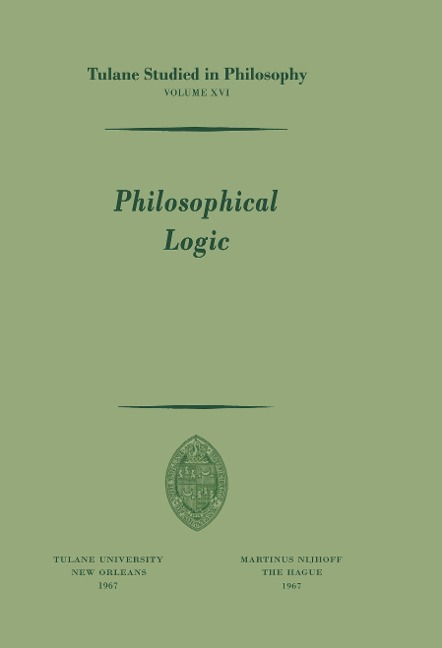
Philosophical Logic - James K. Feibleman,Robert L. Arrington,James W. Dye,John C. Sallis,Louise N. Roberts,Bertrand P. Helm,Peter M. Burkholder,Shannon Dubose,Max Hocutt,Do
James K. Feibleman, Robert L. Arrington, James W. Dye, John C. Sallis, Louise N. Roberts, Bertrand P. Helm, Peter M. Burkholder, Shannon Dubose, Max Hocutt, Do
-40% ar kodu BOOKS
Piegāde 12-18 darba dienu laikā
30 dienu atgriešanas politika
With this issue we initiate the policy of expanding the scope of Tulane Studies in Philosophy to include, in addition to the work of members of the department, contributions from philosophers who have earned advanced degrees from Tulane and who are now teaching in other colleges and universities. The Editor THE LOGIC OF OUR LANGUAGE ROBERT L. ARRINGTON Wittgenstein wrote in the Tractatus that "logic is not ... Pilns apraksts
Jums varētu patikt arī
 TOP
TOP
How Not to Be Wrong: The Power of Mathematical Thinking
-40% ar kodu BOOKS
Piegādātāja noliktavā
 TOP
TOP

Ikigai: The Japanese secret to a long and happy life
Francesc Miralles, Héctor García
-40% ar kodu BOOKS
Noliktavā
TOP
The Artist's Way: A Spiritual Path to Higher Creativity
-40% ar kodu BOOKS
Piegādātāja noliktavā

 TOP
TOP
The Holy Bible - King James Version (KJV): Popular Gift & Award Black Leatherette Edition
-40% ar kodu BOOKS
Piegādātāja noliktavā
TOP
The Daily Stoic: 366 Meditations on Wisdom, Perseverance, and the Art of Living: Featuring new translations of Seneca, Epictetus, and Marcus Aurelius
Stephen Hanselman, Ryan Holiday
-40% ar kodu BOOKS
Noliktavā
TOP

Open Socrates: The Case for a Philosophical Life
-40% ar kodu BOOKS
Piegādātāja noliktavā
TOP

Original Sin: The Genetics of Wrongdoing, the Problem of Blame and the Future of Forgiveness
-40% ar kodu BOOKS
Piegādātāja noliktavā
TOP

The Art of War & Other Classics of Eastern Philosophy
Mencius, Lao-Tzu, Confucius, Sun Tzu
-40% ar kodu BOOKS
Piegādātāja noliktavā
 TOP
TOP

The Reed of God: Mary, Virgin and Mother
-40% ar kodu BOOKS
Piegādātāja noliktavā
TOP

The Power of Now: A Guide to Spiritual Enlightenment
-40% ar kodu BOOKS
Noliktavā
TOP

On the Shortness of Life: Life is long if you know how to use it
-40% ar kodu BOOKS
Piegādātāja noliktavā
TOP

Antifragile: Things That Gain from Disorder
-40% ar kodu BOOKS
Piegādātāja noliktavā
TOP

Thus Spoke Zarathustra: A Book for Everyone and No One
-40% ar kodu BOOKS
Piegādātāja noliktavā
 TOP
TOP

Antifragile: Things That Gain from Disorder
-40% ar kodu BOOKS
Nav noliktavā
Aprašymas
With this issue we initiate the policy of expanding the scope of Tulane Studies in Philosophy to include, in addition to the work of members of the department, contributions from philosophers who have earned advanced degrees from Tulane and who are now teaching in other colleges and universities. The Editor THE LOGIC OF OUR LANGUAGE ROBERT L. ARRINGTON Wittgenstein wrote in the Tractatus that "logic is not a body of doctrine, but a mirror-image of the world. " 1 In line with his suggestion that a proposition is a 'picture', Wittgenstein argued that propositions 'show' the logical structure of the real. He was insistent, however, that "the apparent logical form of a proposition need not be its real one. " 2 As a result of this we can misunderstand the structure of fact. Philosophical problems arise just when "the logic of our language is mis understood. " 3 It is common knowledge that much of this view of logic was rejected by Wittgenstein himself in the Philosophical Investi gations. There we are told that language has no ideal or sublime 4 logic which mirrors the structure of the extra-linguistic world. Consequently, inferences from the structure of language to the structure of that extra-linguistic world are invalid. Reality can be 'cut up' in any of a number of ways by language. Wittgenstein adopted a view of philosophy which would render that discipline a non-explanatory, non-critical study of the multiple ways in which language can be used.
Vairāk informācijas
| Autors | James K. Feibleman, Robert L. Arrington, James W. Dye, John C. Sallis, Louise N. Roberts, Bertrand P. Helm, Peter M. Burkholder, Shannon Dubose, Max Hocutt, Do |
|---|---|
| Izdevējs | Springer Netherlands |
| Series | Tulane Studies in Philosophy |
| Izlaides gads | 1968 |
| Vāka tips | Mīkstais vāks |
| EAN | 9789024702909 |